My Account
 Cart
Cart

 Helpline:
  Recite
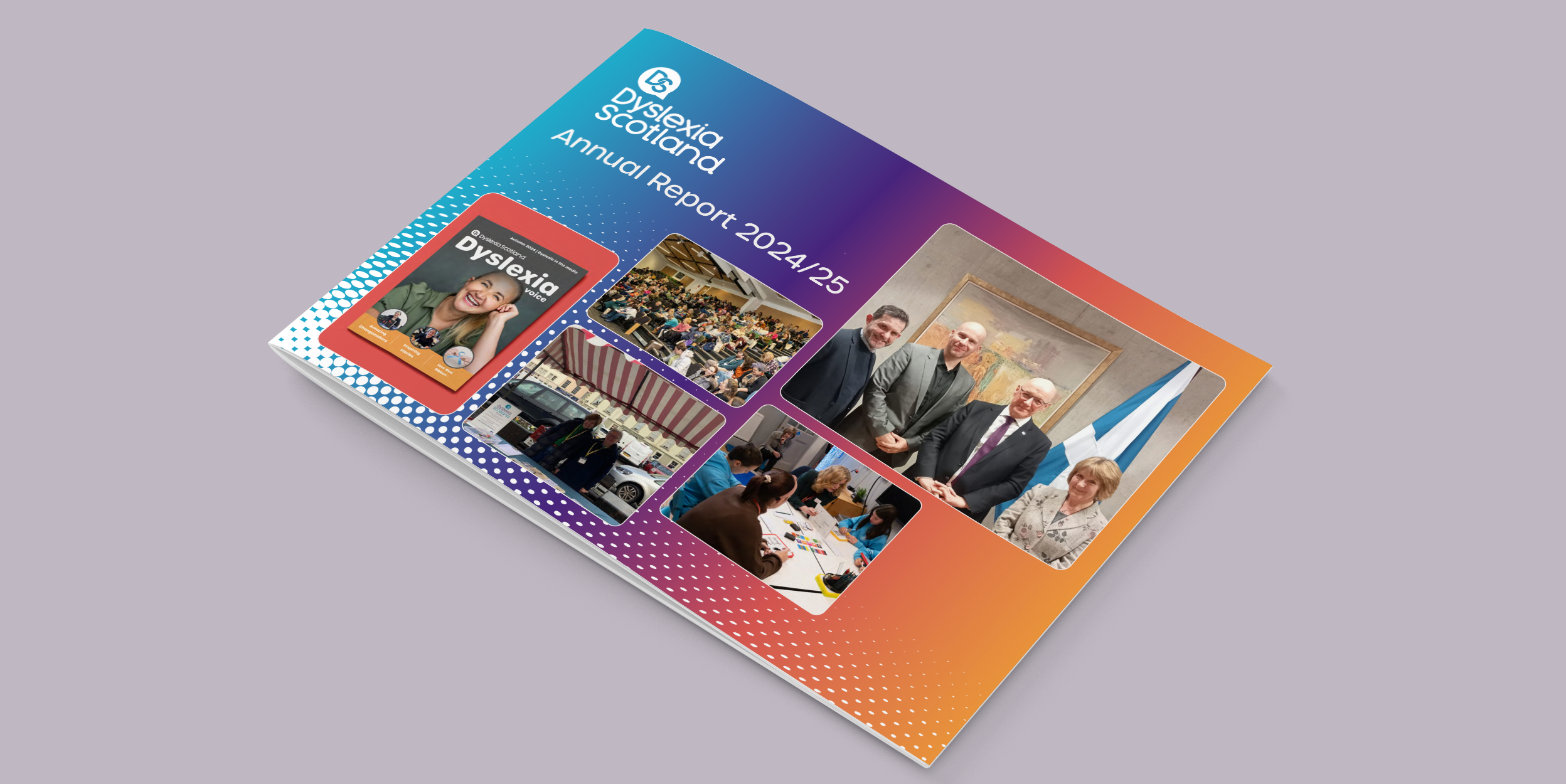
Annual report 2024/5
Introductions
Chair’s report

At the inception of our three-year strategy ‘The journey towards a Dyslexia-Friendly Scotland’, there was a great deal of energy and anticipation as we navigated our way out of the Covid-19 pandemic and into ‘new normal’ ways of living, learning and working.
At that time, we felt our plan was both ambitious and achievable. Reflecting now on our distance travelled, it strikes me how much further we’ve come than we expected.
- Our public profile is strong and positive
- Our partnerships are yielding great success
- The dyslexic community’s voice is strong, clear and effective.
Change is happening.
This annual report, marking the final year of our current strategy, is a part summation of our achievements over the three-year period and part foundation for bigger and better accomplishments.
Yet we know too, because of extensive research and analysis, that there is much work still to be done in Scotland to address persistent inequalities.
We must take time to reflect back – on the phenomenal impacts of our small organisation, and to reflect forwards – what we must tackle next, and how we equip ourselves to take the next steps forward.
David Shaw, Chair of Dyslexia Scotland
Chief Executive’s reflection

The journey towards a dyslexia-friendly Scotland which we embarked upon three years ago was always intended to be a long-term strategy with planned destinations, challenges along the way and changes in the direction of travel where needed. Looking back, it’s been a successful and adventurous time.
The ‘Towards a Dyslexia-friendly Scotland?’ report provides a significant and revealing story about living as a dyslexic adult in Scotland today. Since November 2024, we have shared the findings widely with policy makers and politicians including the First Minister, as well as the media, practitioners, diverse professional networks and changemakers working with adults across sectors. The baseline evidence will help us to review progress made in future years and inform how best to influence change.
We are particularly proud of our ground-breaking professional learning for educators about dyslexia and inclusive practice, including:
- The Sean Connery Dyslexia Initiative in the City of Edinburgh Council. Learning from the programme will continue through two new online modules funded by HSBC UK, currently being developed.
- The strong and inspirational community of teachers who have gained professional recognition awards through our Dyslexia and Inclusive Practice programme. Their commitment to supporting dyslexic learners and changing practice in schools and local authorities during their year-long course and beyond is exemplary.
Our exciting corporate partnership with Morton Fraser MacRoberts began with the sponsorship of the adult survey report. Together, we are working to increase dyslexia awareness and support in Scottish workplaces.
This report captures just a small flavour of the vital work carried out all year round, for dyslexic people of all ages and their families, employers and other professionals. Without our small staff team in the Stirling office, consultants who work on special projects, tutors and assessors on our lists and our network of volunteers in branches and Dyslexic Adult Networks, none of our services would be possible: the Helpline; tutoring; assessments; membership services; websites and social media; events such as Parent Masterclasses, DyslexiFest, Dyslexia Awareness Week and dyslexia training.
Thanks to our supporters
In such a challenging funding climate, the role of the Board of Directors in ensuring good governance and securing sustainable funding is increasingly demanding. I would like to extend my personal gratitude to all of the Directors under David Shaw’s leadership. Their dedication and hard work are exemplary. A very special thanks to those Directors who stepped down during the year and to new ones joining the Board. Our dedicated President, Sir Jackie Stewart, our Vice Presidents, Ambassadors, Young Ambassadors and Council members also all deserve sincere thanks.
I am extremely grateful to our staff team, volunteers, partners and changemakers for their commitment and energy this year in supporting the dyslexic community.
We are very fortunate to collaborate with a wide range of individuals and organisations on programmes, many of whom are featured in this report. We are extremely grateful to them all, as we are to the individual donors, Trusts and Foundations and the Scottish Government. There are many challenges ahead in achieving a Dyslexia Friendly Scotland – the extensive support from those outlined in this report is invaluable.
Cathy Magee OBE, Chief Executive of Dyslexia Scotland
Our journey so far
In 2022, we launched our bold strategy setting out our vision for dyslexia-friendly Scotland. We anticipated a long road ahead, but we were well equipped for the journey, and prepared to progress one step at a time, with the whole dyslexia community – the people we work for, and all the changemakers who support us.
This annual report concludes that plan, and once again, we’re able to stop and reflect on just how far we’ve come.
Leaps and bounds
Advances we made over the three financial years of the strategy include:
2022/23
- The Sean Connery Foundation Dyslexia Initiative | Addressing Dyslexia Addressing Dyslexia established a pioneering dyslexia and literacy support service in partnership with City of Edinburgh Council and the Sean Connery Foundation
- arranged a free tutoring initiative for children and young people
- formed a partnership with the University of Glasgow to plan national research into the lives of adults with dyslexia in Scotland
2023/24
- marked our 55th anniversary
- welcomed Hamza Yassin as a new ambassador
- delivered the Professional Recognition in Dyslexia and Inclusive Practice course to a record number of teachers.
2024/25
Aim 1: High quality services
At the start of our three year-strategy, The Journey to a Dyslexia-Friendly Scotland, we aimed to have 316,500 interactions per year, directly and indirectly with people with dyslexia and changemakers. We’ve far exceeded our targets, as these examples show.
| Three-year total | |
| Helpline enquiries | 5,163 |
| Digital reach | 4.4 million |
| Free assessments | 35 |
| Training participants | 4245 |
| Blue ribbons | 152,196 |
| Event participants | 2330 |
If we laid all the blue ribbons we’ve distributed in the last three years end-to-end, they would reach from the Forth Road Bridge to the Scottish Parliament.
Service innovations
- Continued delivery of the Sean Connery Foundation Dyslexia Initiative. Thanks to this funding, 996 learners from 61 schools in City of Edinburgh Council area have benefitted from the programme. 1752 teachers and Pupil Support Assistants (PSAs) received training to help them support dyslexic learners more effectively.
- We arranged 263 rounds (usually 10 hours per round) of free individual tutoring to 138 children and young people in other parts of Scotland.
- We formed a new Dyslexic Adult Network in Edinburgh.
- We continued to arrange free assessments for adults and young people with dyslexia.
Aim 2: Influencing change
- This year, we’ve leveraged national and strategic partnerships to great effect. By working with partners like the University of Glasgow, MFMac, Education Scotland, the General Teaching Council for Scotland (GTCS), HSBC UK, Youth Scotland and many more, we’ve had influence across sectors, making a difference at grassroots level.
- We committed to having greatest influence in education and we’ve made great strides here. Working alongside Education Scotland and others, we’ve brought about real change in Scotland’s schools and learning spaces.
- 46 teachers gained Professional Recognition in Dyslexia and Inclusive Practice. The GTCS panel has developed a strong community of practice, building expertise and a growing community of alumni. At the time of writing, our fourth cohort has completed the programme – a total of 218 practitioners, with 98 gaining Professional Recognition awards. A further 50 are due to start in September 2025.
- 1201 teachers completed our online training modules.
- We collaborated with Youth Scotland on a guide to supporting dyslexia in the youth work sector and shared this openly.
- We partnered with Beano for Schools on a co-branded Dyslexia Awareness Week resource which was sent to over 20,000 people.
- 222 educators attended our Education Conference.
- We responded to national consultations, including the Learning Disabilities, Autism and Neurodivergence (LDAN) Bill; and the Youth Work Bill; and provided a Scottish perspective to the Delphi review of the definition of dyslexia by an international group of experts’ process of defining dyslexia.
- As well as making changes on the ground, we’re working directly with Scottish Government to address policy issues. We met with First Minister John Swinney to discuss findings from our research with the University of Glasgow and have had ongoing contact with Cabinet Secretary for Education and Skills Jenny Gilruth about best practice for dyslexia support in Scottish schools.
- We’re involved in three Cross-Party Groups in the Scottish Parliament (Dyslexia, Volunteering and Disability).
- Publication of our research report ‘Towards a dyslexia-friendly Scotland?’ also sparked interest in the media, helping us achieve national exposure.
Aim 3: Effective dyslexic voices
Sharing the real-life experiences of people with dyslexia is an important step in bringing about understanding. We’ve aimed to amplify individual and collective voices as a method for driving positive change.
Our groundbreaking research report ‘Towards a dyslexia-friendly Scotland?’ captured the experiences of 1,420 adults with dyslexia in Scotland. By launching the report at the Scottish Parliament, we made a bold statement as a community about the importance of improving inclusion for future generations.
We gave a platform to 86 individuals of all ages and backgrounds to share their dyslexia story, through speaking at events, being featured in a podcast or publishing an article in our website and magazine.
Aim 4: Sustainability, efficiency and effectiveness
While our vision for a dyslexia-friendly Scotland is bold, our pace towards it has to be steady and sustainable.
Over the last year, we’ve explored corporate partnerships to help fund our work, continued to develop and support our volunteer programme and monitored our staff capacity.
- Sponsorship and support from MFMac helped us to disseminate our research report much more widely than we could have managed without their input.
- A grant from HSBC UK is helping us to develop more teacher training modules to share the learning from the Sean Connery Foundation Dyslexia Initiative.
Case study: MFMac

“We were delighted to attend the launch event for Dyslexia Scotland’s new report, ‘Towards a dyslexia-friendly Scotland?’, at the Scottish Parliament. At MFMac, we recognise the vital importance of fostering an inclusive environment where everyone has the opportunity to thrive and be at their best.
Supporting this important report aligns with MFMac’s commitment to champion diversity, inclusion and belonging, in the workplace, and we strive to ensure that reasonable adjustments for neurodiversity are part of our standard practice.”
Case study: HSBC UK
Jonathan Rae, Co-Chair of HSBC UK’s Neurodiversity Committee and Senior Financial Crime Capability Manager at HSBC UK said:
“I’m so proud that HSBC UK is supporting this project, one which is very close to my own heart. As a dad to a dyslexic child, I know how important it is to give him and others like him every opportunity to succeed. What a privilege it is to be able to create an opportunity for Dyslexia Scotland to create essential resources for schools in Scotland.”
Financial overview
A deficit of £24,987 arose during the year (2024: surplus of £26,237). During the year, eighteen (2024: eighteen) branches operated under the charity number of Dyslexia Scotland and are incorporated in the accounts. At the year end, £478,093 (2024: £503,080) of reserves were carried forward.
During the year, funding was received from the Scottish Government to engage consultants in the following areas: Parent Masterclasses; summer lectures; conference organisation; panel training/fees for GTCS programme; ScotPulse Survey. Funding received from the Sean Connery Foundation was used to pay consultants involved in delivering the Sean Connery Dyslexia Initiative in partnership with the City of Edinburgh Council.
Acknowledgements
Dyslexia Scotland is its people. We are our members, our community of people with dyslexia and changemakers, our President and Vice Presidents, our Ambassadors, our volunteers, our partners and collaborators, donors and sponsors, staff and Board of Directors.
Every individual and organisation who supports our cause deserves our thanks. Here are a few we want to highlight.
Directors
- David Shaw (Chair)
- Mary Evans
- Michael Gibson (Resigned 20 August 2025)
- Chris Hughes (Resigned 13 June 2025)
- David Hughes (Resigned 20 August 2024)
- Andy Laverty (Resigned 20 August 2025)
- Karen McGill
- Peter Lederer
- Irene Lumsden
- David McIntosh (Appointed 22 August 2024)
- Mary Berrill (Appointed 20 August 2025)
- Barry Macintyre (Appointed 20 August 2025)
We are extremely grateful to all our funders and supporters, including individual donors, those who raise money through sponsorship activities and provide important in-kind support.
Donors
Our sincere thanks go to the following donors for their generous contributions towards our core costs, our staff salary costs, the Sean Connery Foundation Dyslexia Initiative, assessment funds and others to help dyslexic children and adults:
- The Scottish Government
- The Corra Foundation
- Dr Walter Scott
- The Sean Connery Foundation
- The Robertson Trust
- HSBC UK
- The Northwood Charitable Trust
- Cormack Consultancy Group
- Marilyn Lederer
- The Sean Connery Foundation supported the Sean Connery Dyslexia Initiative in Edinburgh. Dyslexia Scotland acts as an ‘agent’ to transfer funding from the Sean Connery Foundation to the City of Edinburgh Council during the Initiative’s 3-year funding period.
Volunteers
Often volunteer contributions to charities are measured in number of volunteers and number of volunteering hours. However this tells us little of the value or impact our volunteers bring to the organisation, the cause or society. The following sections showcase examples of how valuable our volunteers’ impact is.
Branches
Our local branch volunteers raise awareness in their communities. This volunteer’s quote captures the branches’ purpose:
“It’s a privilege to be part of Dyslexia Scotland and volunteer within the Lanarkshire Branch. As a volunteer, sharing knowledge and lived experience empowers individuals and families to realise that they are not alone and support is out there.”
National Volunteers
Case study: Volunteer Photographer Dave

Dave is a photographer by trade, giving us the benefit of his professional skills. Dave captures our impactful work through photographing events like the Education Conference and works closely with our Lead for Creative and Digital to provide photography for our campaigns work. Dave captured the sombre portraits of research participants to help us present the human faces behind the data.
Dave said: “I especially enjoyed working on the Dyslexia Awareness Week campaigns, creating images that could be developed into interesting concepts by the talented creative team in Dyslexia Scotland. I think my favourite campaign was when I visited people at their places of work showing how their dyslexia wasn’t a barrier to them succeeding in life and work especially when workplaces provided the support required. I hope, with the continued work of Dyslexia Scotland, everyone in Scotland, no matter the issues they face, eventually can have the opportunity to succeed.”
Ambassadors
Ambassadors help us raise our public profile.
Case study: Hamza Yassin

Wildlife cameraman Hamza Yassin has added sparkle and glamour to our Dyslexia Awareness Week activities these last two years, launching his two books in our home-town of Stirling.
In the spirit of Dyslexia Awareness Week, Hamza shared the challenges he faced as a younger person with dyslexia alongside how he thrived in his work as a wildlife cameraman, eventually becoming confident enough to write books.
Hamza said: “I’m delighted to… talk about my dyslexia journey. It’s so important to send out positive messages to younger people about making the most of their learning difference and I’m very proud to be able to do it in support of Dyslexia Scotland.”
Case study: Paul McNeill

Paul contributes to our work in all kinds of ways, most notably as Secretary to the Cross-Party Group on Dyslexia in the Scottish Parliament.
He’s widely known as co-author of Mission Dyslexia, an educational resource that encourages strength-based approaches in learning. The materials are a core feature of The Sean Connery Foundation Dyslexia programme we run with City of Edinburgh Council.
Case study: Mark Stoddart

Mark consistently flies the flag for dyslexia and Dyslexia Scotland, through displays at conferences around the UK, people he meets across the world and in regular press articles about his role. Mark’s incredible generosity to support dyslexia, mental health and inequalities, both nationally and internationally, has been well documented in Dyslexia Voice magazine and beyond.
We are very grateful to Mark for regularly donating royalties from his sculptures and the book, ‘Making a Mark!: Discovering the Power of Neurodiversity on a Learning Safari’ to Dyslexia Scotland.
Strategic partners and collaborators
Case study: RSABI
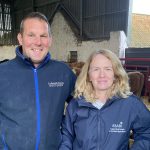
Scottish agricultural charity RSABI worked with Dyslexia Scotland to raise awareness of the challenges many people involved in farming face with dyslexia.
Around 25% of Scotland’s farmers are estimated to be dyslexic. RSABI has been offering farmers and crofters who may have dyslexia, but have never been assessed, a free professional assessment.
Case study: Dr Law, University of Glasgow

Dr Jeremy Law from the University of Glasgow led our research into the experiences of adults with dyslexia in Scotland last year. The resulting report, ‘Towards a dyslexia-friendly Scotland?’ has a wealth of data that helps us to understand the issues we need to address. Since undertaking the project, Dr Law has become our Affiliate Researcher, providing a research perspective on key areas of work.
Case study: Laura Starkey, Education Scotland

Laura Starkey is a CLD Education Officer at Education Scotland and serves as a co‑chair of the Specific Learning Difficulties Network for Community Learning and Development practitioners, which is collaboratively run by Education Scotland and Dyslexia Scotland. This network is dedicated to supporting Community Learning and Development professionals in understanding and effectively supporting people with dyslexia.
Case study: The Addressing Dyslexia Toolkit working group
The Addressing Dyslexia Toolkit Working group, ably chaired by Fran Foreman, is the professional collaborative responsible for developing, maintaining, and guiding the Addressing Dyslexia Toolkit – the free, online resource designed to support educators and practitioners across Scotland in identifying and supporting learners (aged 3‑18) with dyslexia. The national resource houses templates, materials and best practice recommendations for supporting dyslexic learners in Scottish schools.
Download the printable report